Overview & Intent
Acquire 3–5 acres within ~90 minutes of ATL (initially purchased in personal names), subdivide into usable zones, and proceed with a dual path: Camille transitions RV → modular home with homestead planting; Kolby builds a stick-built Kono Mini first, then the larger KONO, with the Kono Mini becoming a guest/Airbnb unit later. Keep ~1.5 acres as a wooded family reserve for future builds.
Family Compound & Homestead Plan (5 ac Layout)
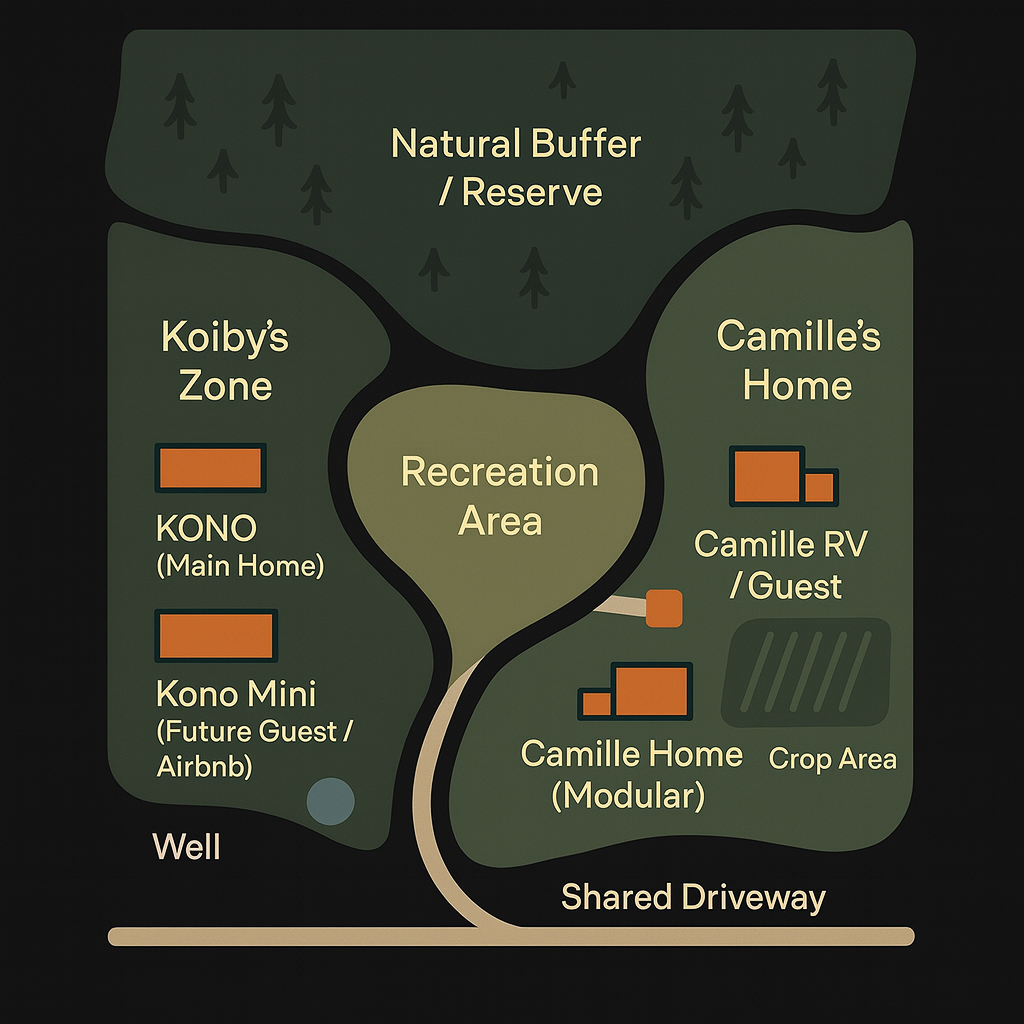
“Concept layout for Kolby & Camille’s 5-acre family compound — an organic homestead plan featuring dual home zones, RV guest suites, a shared recreation meadow, and a wooded family reserve for future builds.”
Allocation
| Use | Acreage | Notes |
|---|---|---|
| Kolby’s Zone — homes (Kono Mini & KONO) | ~1.0 ac | Space for Kono Mini (Phase 1) and future KONO (Phase 3) with garden, septic, and drive spur. |
| Camille’s Zone — home | 0.75 ac | Future modular home + kitchen garden and crop access. |
| Camille RV / Guest | 0.25 ac | RV guest suite near homestead; can share utilities with modular home. |
| Shared Recreation Meadow | 0.25 ac | Firepit · picnic shelter · overflow camping/gatherings. |
| Family Reserve (wooded) | ~2.75 ac | Future family build(s); keep natural for now. |
Organic Layout Principles
- Curving shared driveway loop reduces grading and fits topography
- Homes tucked at edges for privacy; meadow in the center for family use
- Single well with split lines; two septic fields (one per home+RV pair)
- Plan utility stubs toward the reserve area for future builds
- Preserve trees for shade/windbreak and better stormwater behavior
Kolby’s Roadmap & Timeline (realistic, budget-aware)
Timeline aligned with Kolby’s savings milestones, Euro Week 2026, and a phased stick-built path: Kono Mini first, then KONO, with Airbnb income only after the main house is complete.
| When | Milestone | What Happens | Why It Matters |
|---|---|---|---|
| 2025–2026 | Stabilize & Scout (Euro Week protected) | Keep existing loan payoff and savings plan on track; protect Euro Week 2026 travel budget. Start soft research on target counties, talk to Planning about stick-built homes, homesteads, and minor subdivision rules. | Respects current obligations and trip goals while quietly prepping the land move. |
| 2027 | Land Fund Focus | Shift freed-up cash toward a dedicated land fund. Narrow to 2–3 best counties based on budget, drive time, and demographics. Begin talking with surveyors and well/septic contractors for ballpark pricing. | Builds a realistic down-payment and pins down true infrastructure costs. |
| Q4 2027 – Q2 2028 | Pre-Qual & Offer Window | Get pre-qualified for a land loan in your personal names. Walk short-listed parcels. When a 3–5 acre tract ≤ $70k fits the plan, make an offer with contingencies (perc test, access, basic subdivision feasibility). | Targets land purchase at a point when savings and debt pay-down are aligned. |
| Q3 2028 – Q2 2029 | Phase 1: Infrastructure + Design | After closing, install core infrastructure: shared driveway, well, and first septic system. Begin detailed design and budgeting for the stick-built Kono Mini using the concept floor plan as a guide. | Makes the land usable, sets the layout for both homes, and keeps things cash-flow aware. |
| Q3 2029 – Q4 2030 | Phase 2: Build Kono Mini (stick-built) | Construct the Kono Mini as Kolby’s first on-site home: simple, efficient, and sized to your budget. Move in when finished; use it as primary residence while long-term loans are paid down. | Gives a stable home on the land without jumping straight to full KONO costs. |
| 2031 – 2032 | Live in Kono Mini & Reset for KONO | Live in the Kono Mini, prioritize paying down the first 401(k)/personal loan tranche, refine the full KONO design, and update build pricing. No RV or Airbnb operations yet—this is the “stabilize and plan” window. | Lowers debt, lets construction costs settle, and keeps life simple on the land. |
| 2032 – 2033 | Phase 3: Build KONO (main home) | Start construction on the stick-built KONO main home, including attached garage/storage as shown in the concept plan. Move from the Kono Mini into KONO once inspections are complete. | Completes Kolby’s long-term home while keeping the Mini intact as a future asset. |
| 2033+ | Phase 4: Kono Mini → Guest / Airbnb | Convert the Kono Mini into a dedicated guest house or Airbnb unit, once life in KONO is stable. At this point, consider forming or activating an LLC to hold income-producing use (Mini rental, any shared events, etc.). | Turns the original home into an income-capable asset and formalizes “business mode.” |
This roadmap assumes a conservative savings pace, protects Kolby’s existing travel plans, and spaces out major construction so cash flow, loans, and life bandwidth all stay manageable.
Land Realtor Engagement Plan & Leads
When to Bring in a Land Realtor
| Timing | Action | Goal |
|---|---|---|
| Q4 2027 | Interview 3–4 land-focused agents (phone/Zoom). Share this deck and target counties. | Find a pro who knows wells, septics, minor subdivisions, and RV/modular rules. |
| Jan–Mar 2028 | Select agent & sign a buyer‑broker agreement (≤ 6‑month term; counties listed). | Lock representation before showings; avoid dual‑agency where possible. |
| Apr–Sep 2028 | Active showings and comps; agent schedules perc letters, utility verification, and driveway feasibility. | Prepare an offer with strong contingencies. |
| Q4 2028 | Due diligence coordination (survey, soil, Planning letters). Negotiate credits if utilities are distant. | Close on land with risk checked. |
If rates/inventory shift, slide these windows, but keep the sequence: interview → select → showings → DD → close.
Agent Vetting Checklist
- Recent 3–5 acre rural deals in: Walton, Carroll, Haralson, Bartow, Jackson, Paulding, Polk
- Comfort with perc tests, septic sizing, and well siting
- Understands minor subdivision and flag‑lot access rules
- Knows RV temporary dwelling rules & modular home standards
- Can read plats, flood maps, soil maps; calls utilities to verify service distance
- Has surveyor, well/septic, and driveway/grading vendor bench
Email Script
Subject: Buyer seeking 3–5 acre rural parcel within ~90 min of ATL (future LLC, minor subdivision, RV guest + stick-built homes)
Hi <Name>, I’m building a small family compound with my cousin (counties: Walton, Carroll, Haralson, Bartow, Jackson, Paulding, Polk). Budget ≤ $70k for 3–5 acres. We’ll need help validating RV guest use, stick-built home and modular placement, and a minor subdivision. Could we talk through your recent similar deals and vendor contacts (surveyor, soil, driveway)? — Kolby
Shortlist: Georgia Land-Focused Brokerages/Teams
| Brokerage / Team | Coverage | Why on the List |
|---|---|---|
| Southeastern Land Group (SELG) | Statewide GA | Dedicated land agents; rural utilities & soils familiarity; hunting/farm tracts overlap. |
| Mossy Oak Properties – Georgia | North & West GA | Rural land specialists; frequent 3–10 ac listings in target counties. |
| Whitetail Properties – Georgia | North GA | Land‑only focus; good at access/driveway and topo issues. |
| National Land Realty – Georgia | Statewide GA | Land comps, mapping tools; cross‑county coverage. |
| United Country Real Estate (Land & Lifestyle) | Statewide (franchise offices) | Mixed rural brokers; often handle small splits and farmettes. |
| KW Land (Keller Williams Land) | Metro West / North Metro | Land division inside a big shop; easier scheduling and county reach. |
| Better Homes & Gardens Metro Brokers – Land Div. | Atlanta Metro | Large network; can pair you with a land‑savvy sub‑team for each county. |
Use this list to source specific agents in each county. Always ask for addresses of their last 3 rural closings and call those buyers.
Target Counties (Shortlist) + Locator
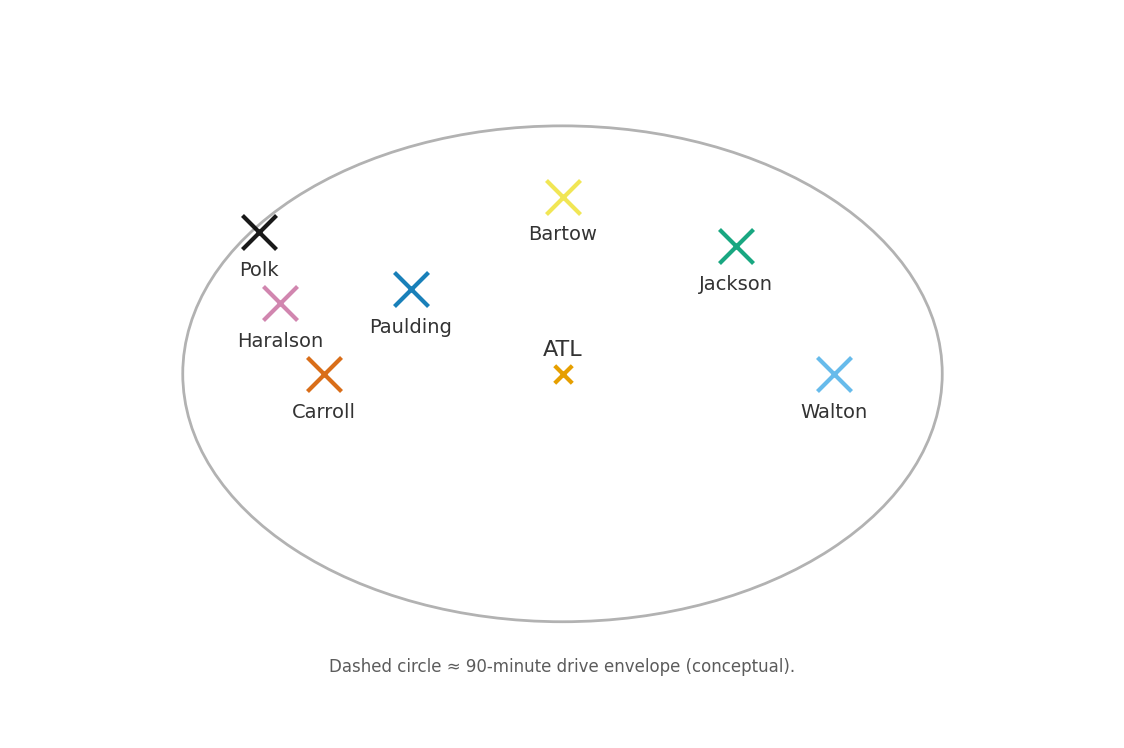
Counties: Walton · Carroll · Haralson · Bartow · Jackson · Paulding · Polk. See demographics and live sample listings below for context.
Live Sample Listings
| County | Acreage | Price | $ / Acre | Est. Taxes | Road / Utilities | Value Rank |
|---|---|---|---|---|---|---|
| Walton | 3.4 ac | $62,500 | $18.4k/ac | $440/yr | Paved · Power/Water at street | Mid |
| Walton | 4.8 ac | $69,900 | $14.5k/ac | $485/yr | Paved · Well needed | Mid |
| Carroll | 3.2 ac | $54,900 | $17.1k/ac | $395/yr | Paved · Power nearby | High |
| Carroll | 5.0 ac | $59,000 | $11.8k/ac | $410/yr | Gravel · Perc available | High |
| Haralson | 4.1 ac | $47,500 | $11.6k/ac | $355/yr | Paved · Light restrictions | High |
| Haralson | 3.8 ac | $45,000 | $11.8k/ac | $345/yr | Gravel · Easy build site | High |
| Bartow | 3.6 ac | $63,500 | $17.6k/ac | $420/yr | Paved · Power at road | Mid |
| Bartow | 4.2 ac | $69,000 | $16.4k/ac | $455/yr | Paved · Mild topography | Mid |
| Jackson | 3.0 ac | $60,000 | $20.0k/ac | $515/yr | Paved · Major growth corridor | Premium |
| Jackson | 4.7 ac | $69,500 | $14.8k/ac | $540/yr | Paved · Good soils | Premium |
| Paulding | 3.5 ac | $57,000 | $16.3k/ac | $375/yr | Gravel · Power at street | Mid |
| Paulding | 4.9 ac | $68,900 | $14.1k/ac | $420/yr | Gravel · Multiple homesites | Mid |
| Polk | 3.7 ac | $44,900 | $12.1k/ac | $325/yr | Gravel · Utilities ~400 ft | High |
| Polk | 5.1 ac | $52,000 | $10.2k/ac | $345/yr | Paved · Flat & buildable | High |
“Value Rank” compares price, road access, utility proximity, topo, and development difficulty. These sample listings show what the market typically offers for 3–5 acres under $70k across all seven counties.
Demographics & Growth Snapshot (rounded)
| County | Population | Median Income | Median Home Value | 5‑yr Trend | White | Black | Hispanic | Other/Multi | Vibe |
|---|---|---|---|---|---|---|---|---|---|
| Walton | ~106K | ~$82K | ~$300K | Modest growth | ~70% | ~20% | ~6% | ~4% | 🔵 Stable Value |
| Carroll | ~122K | ~$72K | ~$265K | Modest growth | ~67% | ~20% | ~8% | ~5% | 🔵 Stable Value |
| Haralson | ~31K | ~$65K | ~$230K | Flat to modest | ~90% | ~5% | ~2% | ~3% | 🟣 Budget-Strong |
| Bartow | ~104K | ~$79K | ~$295K | Growing corridor (I‑75) | ~74% | ~11% | ~10% | ~3% | 🟢 Growth Hotspot |
| Jackson | ~81K | ~$85K | ~$325K | Fast growth (Athens‑ATL arc) | ~77% | ~7–8% | ~9–10% | ~4% | 🟢 Growth Hotspot |
| Paulding | ~176K | ~$94K | ~$320K | High suburban growth | ~64% | ~22% | ~8% | ~6% | 🟢 Growth Hotspot |
| Polk | ~43K | ~$55K | ~$200K | Flat to modest | ~71% | ~12% | ~13% | ~4% | 🟣 Budget-Strong |
Figures are rounded for presentation clarity and planning context. Confirm with county/Census sources during due diligence.
Shared Infrastructure & Utility Plan
Site Systems
- 400-amp main service split between the two future homes: 200A to Kolby’s side (Kono Mini → KONO) and 200A to Camille’s side. RV pedestals on smaller subfeeds.
- Shared well placed centrally on the property with a pressure tank and isolated lines to both zones. Future branch line for Camille’s crop area.
- Two septic systems — one sized for Kolby’s stick-built homes (Mini + future KONO), one for Camille’s modular home + RV guest suite. Both planned with long-term capacity in mind.
- Internet & cell: verify fiber availability by road; if unavailable, use high-gain directional antenna + 5G home internet for early years.
Phasing
- Phase 1: Driveway access, initial clearing, well siting, and temporary construction power.
- Phase 2: Install first septic system and fully enable Camille’s RV guest use; set utility paths for future homes.
- Phase 3: Build Kono Mini (Kolby) and prepare site layout for Camille’s future modular home.
- Phase 4: Add second septic, extend utilities to Camille’s modular home site; refine recreation area.
- Phase 5: Build KONO (Kolby) and extend power/water stubs toward the reserve area for future family build-ins.
Shared Investment Plan (Kolby + Camille)
Clear, family-first framework for funding land and early infrastructure. Shared costs apply to anything that benefits both zones. Personal costs apply to each person’s home and private systems. No reimbursements later — this is long-term family land.
Shared Costs (Split Evenly)
| Item | Why Shared? |
|---|---|
| Driveway installation | Primary access for both homes and all future builds. |
| Clearing main access path | Required for emergency vehicles, delivery trucks, and setup. |
| Shared well + pressure system | Feeds both zones; much cheaper than two individual wells. |
| Main water trunk line | Splits from the well to both home sites. |
| Power pole + 400A service | Single main drop, split 200A/200A for both homes. |
| Internet installation | Fiber or 5G equipment shared at entry point. |
| Survey (boundary + concept plat) | Needed to visualize zones + future minor subdivision. |
| Minor subdivision plat (later) | Formalizes Kolby’s Zone, Camille’s Zone, and the Reserve. |
| Recreation meadow setup | Shared family gathering area; benefits all users. |
| Drainage / road grading | Protects the shared driveway and reduces erosion. |
Personal Costs (Individual Responsibility)
| Person | Personal Items |
|---|---|
| Kolby | Kono Mini foundation + build · Kono Mini septic · KONO foundation + build · KONO septic · Any private drive spur · Personal landscaping. |
| Camille | RV pad improvements · Modular home foundation + build · Modular septic · Personal landscaping + crop area setup. |
Family-First Principles
- No reimbursements. If one person pays early, it is treated as a gift toward the shared vision.
- Shared systems improve the whole property. Anything that touches both zones is a shared cost.
- Homes are personal investments. Each person pays for their own dwelling and their own septic.
- Future family builds contribute later. If a relative builds in the reserve, they buy into shared infrastructure.
This structure keeps things fair, simple, and emotionally clean — no “IOUs,” no future accounting headaches, and no mismatched expectations. Both zones grow together as the land improves.
Next 10 Actions
- Confirm county rules for your use case. Call Planning in 2–3 top counties to verify what’s allowed on 3–5 acres: two stick-built homes (Kono Mini + KONO / Camille modular), Camille’s RV as guest use, small crop area, and a future minor subdivision.
- Refine the land + infrastructure budget. Update your numbers for target land price (≤ $70k), closing costs, and ballpark costs for a shared driveway, well, and two septic systems.
- Shortlist active parcels. Build a list of 6–10 real listings in the target counties that meet: 3–5 acres, price ≤ $70k, and drive time ≈ 90 minutes from ATL. Update your leads table with $/acre and est. taxes.
- Talk to 1–2 surveyors. Ask about pricing and timing for (a) a concept plat showing your 5-acre layout and (b) a future minor subdivision when you’re ready to formalize Kolby’s Zone, Camille’s Zone, and the reserve.
- Talk to well & septic pros. Get rough quotes for one well and two septic systems for stick-built homes plus guest/RV use, so your budget lines up with reality.
- Start builder discovery for stick-built homes. Identify a small list of builders/GCs who are comfortable with: (1) a simple Kono Mini starter home and (2) the larger KONO plan, plus modular-friendly builders for Camille’s future home.
- Check land loan options in your personal names. Talk with at least one land-focused lender and one credit union/bank to confirm down payment, interest rate range, and how a later construction loan for Kono Mini would work.
- Walk the top 2–3 parcels. Visit in person to confirm access, slope, neighboring uses, sight lines, and power-pole distance. Take photos and notes for Camille.
- Lock in your phasing plan. Finalize the sequence for: land purchase → Kono Mini build → Camille’s modular home → KONO build → Kono Mini becoming guest/Airbnb. Reflect this in your timeline card so everyone sees the same path.
- Prepare the offer checklist & be ready to pull the trigger. When the finances line up and the right parcel appears, make an offer with contingencies for perc test, access, basic subdivision feasibility, and utility verification.
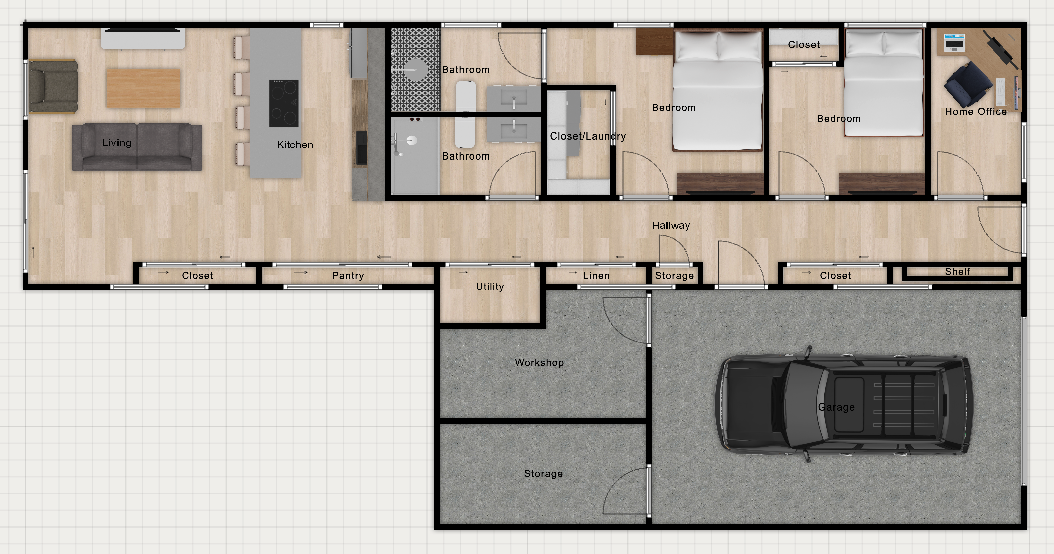
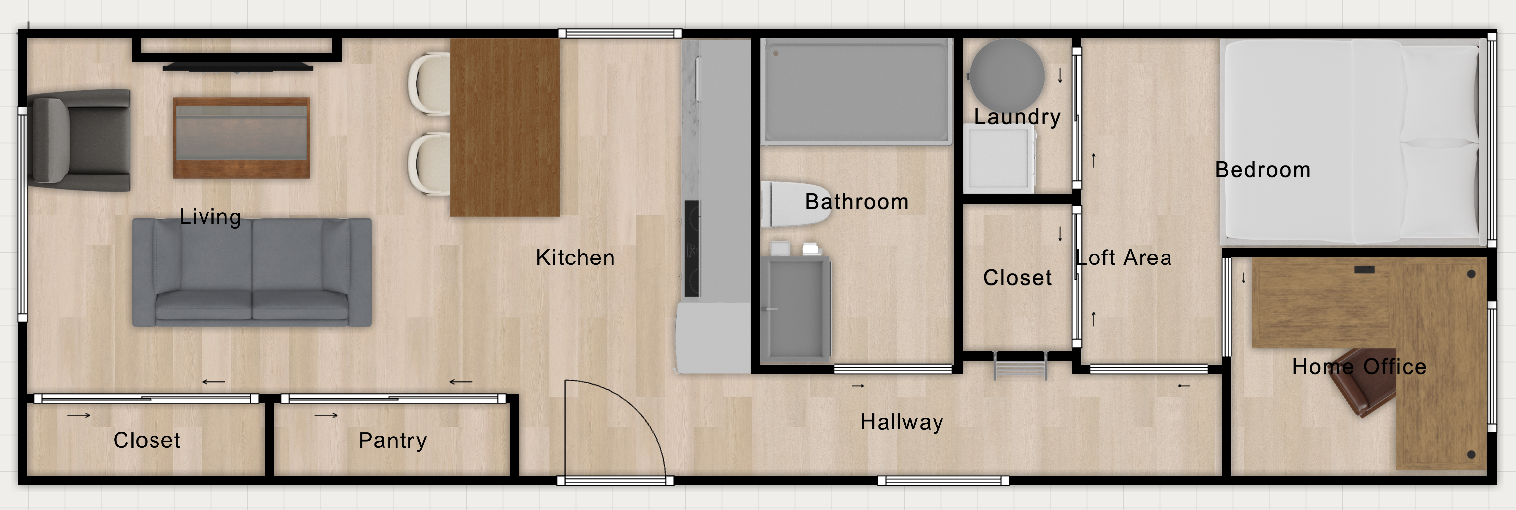
Appendix: Floor Plans — Kono Mini & KONO
Stick-built concept layouts for planning, zoning, and family visualization.
Kono Mini — Concept Plan
KONO — Main Home Concept Plan